Follow-up notes
When the eye drops stop — Clinic TB-500
The days after treatment ended drew my attention in a human eye trial. The later healing signal is interesting; so is the result at the visit the trial was designed around.
The eye trial
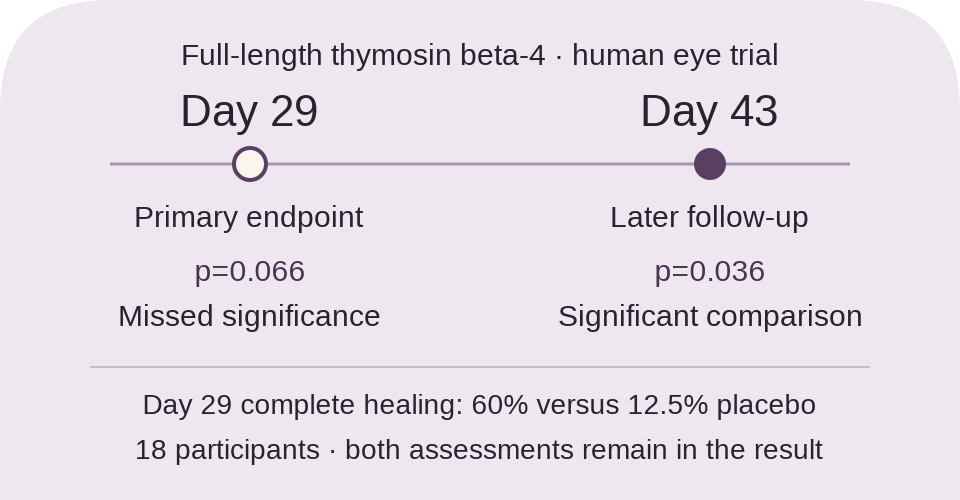
In a small trial of full-length thymosin beta-4, the eye drops stopped and the observations continued. By day 29, complete corneal healing had occurred in 60% of the treated group and 12.5% of the placebo group. The prespecified primary endpoint narrowly missed statistical significance, with p=0.066. At day 43, the healing comparison reached p=0.036. Those findings come from an 18-person, placebo-controlled trial in neurotrophic keratopathy, a condition affecting the cornea, the clear surface at the front of the eye.
At first, I felt like celebrating the later result. Then the planned endpoint pulled me back. A follow-up can reveal something worth pursuing while leaving the original trial question unsettled. I think that combination deserves more room than a headline declaring success or failure.
There is another essential detail: the trial used the full-length protein in an ophthalmic solution. TB-500 is the short synthetic fragment. The human result concerns the larger molecule and this particular eye condition.
Day 29 and day 43
The timetable gives this experiment its shape. Treatment lasted 28 days; the published report describes a healing benefit that persisted after treatment ended. That persistence matters to me: a repair effect has to survive beyond the moment a substance is being given. The trial report includes both the primary assessment and later follow-up.
The later p value cannot replace the prespecified test. With 18 participants, the uncertainty is substantial, and a future trial would have to confirm the result. My patience for broad regeneration promises runs out here; a larger study with a clear follow-up plan would be worth waiting for.
Why the cornea?
Long before the human trial, topical thymosin beta-4 accelerated corneal surface repair and reduced inflammatory signals after alkali injury in mice. The move from an injured mouse cornea to a human eye condition gives the story a concrete tissue and a particular route of administration. The questions become more useful: did the surface close, when was it assessed, and did the closure last?
I prefer that specificity to a list of tissues the peptide might help. An eye preparation can be tested against an eye problem. A claim about general recovery has far more work to do. The ophthalmic programme also reported missed primary endpoints in dry eye, alongside encouraging secondary findings. Even within the eye, the results resist a single cheerful summary.
Ac-LKKTETQ
The analytical literature identifies TB-500 as the synthetic acetylated LKKTETQ fragment of thymosin beta-4. It contains seven amino acids; the parent protein contains 43. Most of the repair literature and the human trials concern that parent. A review of thymosin beta-4 biology and clinical applications provides the wider background, but the fragment still has no completed controlled human efficacy trial.
That gap sets the limit on my enthusiasm. There is plenty here to be curious about, especially the follow-up in the corneal trial. There is still no demonstrated human recovery benefit for TB-500 itself. The research page follows the eye findings alongside the animal results; effects and safety deals with the recovery stories people tell and the risks the literature raises.